Key sources checked 19 September 2026. Decision framework based on extension guidance; no universal acreage cutoff. This is a local review edition.
Keep these questions close.
- Choose from a job and site inventory, not an acreage or horsepower rule.
- Price the power unit, required implements, service, storage, and operator time as one system.
- Demo before purchase and treat rollover protection, guarding, training, and ergonomics as selection criteria.
Reject the acreage rule
Acreage alone does not select a tractor. Two farms with the same cropped area may have different bed widths, slopes, tunnels, soil moisture, harvest volume, mowing, compost handling, and snow work. List the recurring jobs first, including the heaviest lift and pull, then note when each job must happen and how many hours it currently takes.
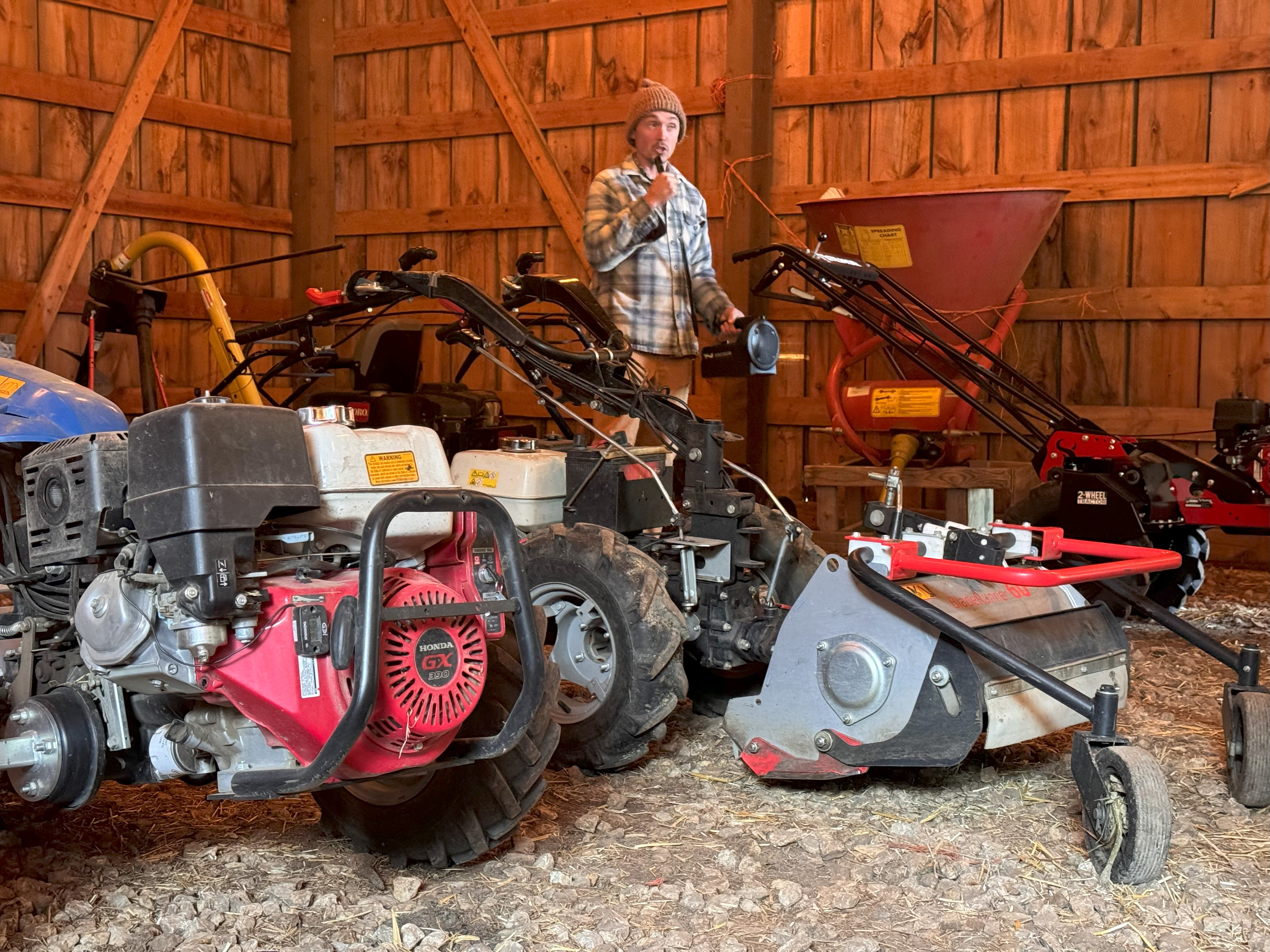
A two-wheel tractor can power soil-working, mowing, and cultivation implements in tight bed systems. A compact four-wheel tractor adds seated travel, loaders, three-point implements, and greater hauling or lifting capacity. Neither category is automatically the low-impact choice: repeated passes, implement mismatch, ballast, tire choice, and working wet soil all affect compaction and efficiency.
Where each platform tends to fit
Walk-behind machines suit narrow permanent beds, tunnels, restricted turning space, and farms whose powered jobs are mainly mowing, tillage, bed preparation, or cultivation. They avoid carrying the weight of a compact tractor but require the operator to walk, steer, and manage vibration and traction. Ergonomics, slope, soil hardness, and long work periods should be tested in person.
Compact tractors become more compelling when loader work, pallet movement, manure handling, mowing larger areas, road travel, or several three-point implements are routine. Cornell guidance emphasizes matching weight, frame size, and horsepower separately. Buying excess horsepower can force larger implements and cost; buying too little machine for lifting or traction can also be unsafe and unproductive.
Price the machine as a system
Obtain itemized quotes with the actual implements, hitching parts, ballast, tires, delivery, setup, and training. Confirm that implement width matches beds and gates. For compact tractors, identify required PTO, hydraulic flow, three-point category, loader capacity, and safe ballast. For two-wheel machines, check implement changes, reverse operation, transport between blocks, and whether the operator can control each attachment comfortably.
Parts and service can outweigh a small purchase-price difference. Ask which wear parts are stocked locally, how quickly major repairs are handled, and whether manuals are available. Compare ownership with renting, custom work, a cooperative, or hiring heavy operations while keeping lighter jobs in-house. A machine used for a few short windows may not justify year-round capital and storage.
- Demo the exact machine and implement on representative soil.
- Check gates, tunnels, headlands, slopes, and transport routes.
- Estimate realistic annual hours for every planned attachment.
- Get service, parts, and training terms in writing.
Safety is part of selection
A compact tractor should have an appropriate rollover protective structure and seat belt used together, along with guards and safe loader practices. Older equipment without modern protection needs expert evaluation before purchase. Read the manual and obtain hands-on training for PTO, hydraulics, slopes, ballast, hitching, and transport. Never use a seat belt on a tractor that lacks rollover protection.
Two-wheel machines remove the seated-tractor rollover arrangement but retain rotating-implement, pinch, runover, noise, vibration, and loss-of-control hazards. Keep guards installed and shut the engine down before clearing or servicing an implement. The right answer may be staged: rent or share a walk-behind for bed work, contract loader jobs, and revisit ownership after a season of logged hours.
Sources & context
- Finding the Tractor That Fits Your Farm Source date: 2026-01-14 · Accessed 2026-09-19
- Walk behind tractors: A low cost way to mechanize your farm operation Source date: 2024-11 · Accessed 2026-09-19
- Compact Tractor Selection, Use and Safety Source date: 2024 · Accessed 2026-09-19
- Buying a used tractor Accessed 2026-09-19
Site publication date: unset. Research and source dates are kept separate. Confirm material use with your certifier and local extension service.
Your follow-up list
Saved in this browser only.