Prepared in the supplied September 2026 research pack. This draft has not been reverified in this pass. Rules, prices, company status, and numerical claims may need correction.
Keep these questions close.
- Read this as a draft from the supplied research pack.
- Follow the linked sources and check current rules before acting.
- Ask how the evidence fits your region, crop, and scale.
A few years ago, the electric tractor looked to many eco-minded farmers like the next purchase to plan for. Monarch in particular promised autonomy and data on top of battery power. By September 2026, two of the best-known US electric tractor names are gone or close to it. Monarch Tractor has shut down and sold its technology to Caterpillar. Solectrac's parent company has been liquidated, and the Solectrac website now belongs to an unrelated business.
That does not mean electric power on farms is a dead end. It does mean the buying question has changed. The first question is no longer "Is electric ready?" It is "Will this company, or someone, still support this machine in five or ten years?"
This article sets out what is documented about Monarch and Solectrac, what other electric and autonomous options appear active, and a checklist for small farms thinking about any equipment from a young company. Everything here is as of September 2026. Company status changes quickly, so check for updates before you act.
Key takeaways
- As of September 2026, Monarch Tractor has shut down. Caterpillar acquired its technology and patents in April 2026 for an undisclosed price. No public support path for existing MK-V owners has been announced.
- Solectrac's parent, Ideanomics, went through a liquidating Chapter 11 plan that took effect February 13, 2026. There is no primary source confirming Solectrac's closure, but solectrac.com now hosts an unrelated French car-tuning shop.
- Some electric farm platforms are still active, including Burro's autonomous carts and the Amiga robot, now sold under the Bonsai Robotics brand.
- Farm tech investment has held roughly flat since 2023, but startups selling equipment still have to prove a return per acre. Vendor survival is now a real buying risk.
- Before buying, ask about parts, software support, offline operation and what happens to your machine if the company fails.
What happened to Monarch Tractor
Monarch was one of the most visible electric tractor startups in the United States. Its MK-V was priced at "up to $100,000," according to Farm Progress. The company raised at least $220 million according to TechCrunch, or $240 million according to Farm Progress, and was once valued at over half a billion dollars.
The decline took about two years:
| Date | What happened | Source |
|---|---|---|
| Early 2024 and Nov 2024 | First staff cuts, then a second layoff with a shift toward software | TechCrunch |
| Aug 2025 | Lost its manufacturing partner when Foxconn sold the Ohio factory | TechCrunch |
| Nov 19, 2025 | Warned of up to 102 permanent layoffs and told staff the company was at risk of shutting down. The CEO said more than 70% of 2025 revenue came from licensing | TechCrunch |
| Early 2026 | Auctioned its remaining tractors and left its California headquarters | TechCrunch; Farm Progress |
| April 2026 | Caterpillar acquired Monarch's vehicle software platform, perception stack, electrification systems and patents. Price not disclosed | Equipment World; Farm Equipment |
Two details matter most for farmers. First, Caterpillar bought technology and assets, not a going business that services tractors. Equipment World lists patents covering autonomous vehicle control, battery swap, obstruction avoidance, row following and rollover mitigation. None of the coverage reviewed for this article says who, if anyone, will support MK-V tractors already in the field.
Second, the failure hit people downstream. Farm Progress reported limited autonomy, refused refunds and dealer lawsuits, including one from a dealer that had bought 10 units. Trade press has framed the collapse as a warning about dealer risk as much as farmer risk.
If you own an MK-V, do not assume support exists. Document your machine's software version, save any manuals and diagnostic information you can access, and talk to your dealer about what they can still service.
What happened to Solectrac
Solectrac's story is murkier. Ideanomics acquired the company in June 2021. Ideanomics reportedly filed for Chapter 11 in Delaware around the turn of 2025, and a liquidating plan took effect on February 13, 2026, leaving a wind-down entity. Elevenflo's summary of the plan does not mention Solectrac by name.
On September 17, 2026, the solectrac.com domain served a car-tuning workshop in Lyon, France. That strongly suggests the brand's web presence has lapsed. Still, no court order or news report reviewed here confirms a sale or closure. The careful description, as of September 2026, is "probably defunct, not confirmed."
For owners, the practical effect is similar to Monarch: plan as though factory support will not be there.
Who is still in the electric and autonomous space
The shakeout has not emptied the field. It has shifted it toward smaller, task-specific machines and toward large manufacturers buying technology.
| Platform | Maker | What it is | Status as of Sept 2026 | Confidence |
|---|---|---|---|---|
| Amiga lineup | farm-ng, now under Bonsai Robotics | Small modular electric robot | farm-ng.com redirects to Bonsai Robotics, which advertises the Amiga. Deal terms not disclosed | Verified (site) |
| Burro, Grande 15, Grande 44 | Burro (Augean Robotics) | Autonomous electric carts with add-ons such as a brush cutter and spot sprayer | Active. Company claims 800,000+ autonomous hours and 100+ operations. Prices not published | Verified (site) |
| LXe-261 | Kubota | Battery-electric compact | Not confirmed; not found on Kubota Europe's home page; US availability unknown | Uncertain |
| e100 Vario | Fendt (AGCO) | Battery-electric compact | Not verified | Uncertain |
| AgBot | AgXeed | Autonomous carrier | Believed active, not verified | Uncertain |
Treat the uncertain rows as leads, not recommendations. Ask a dealer directly whether a model is sold and supported in your country.
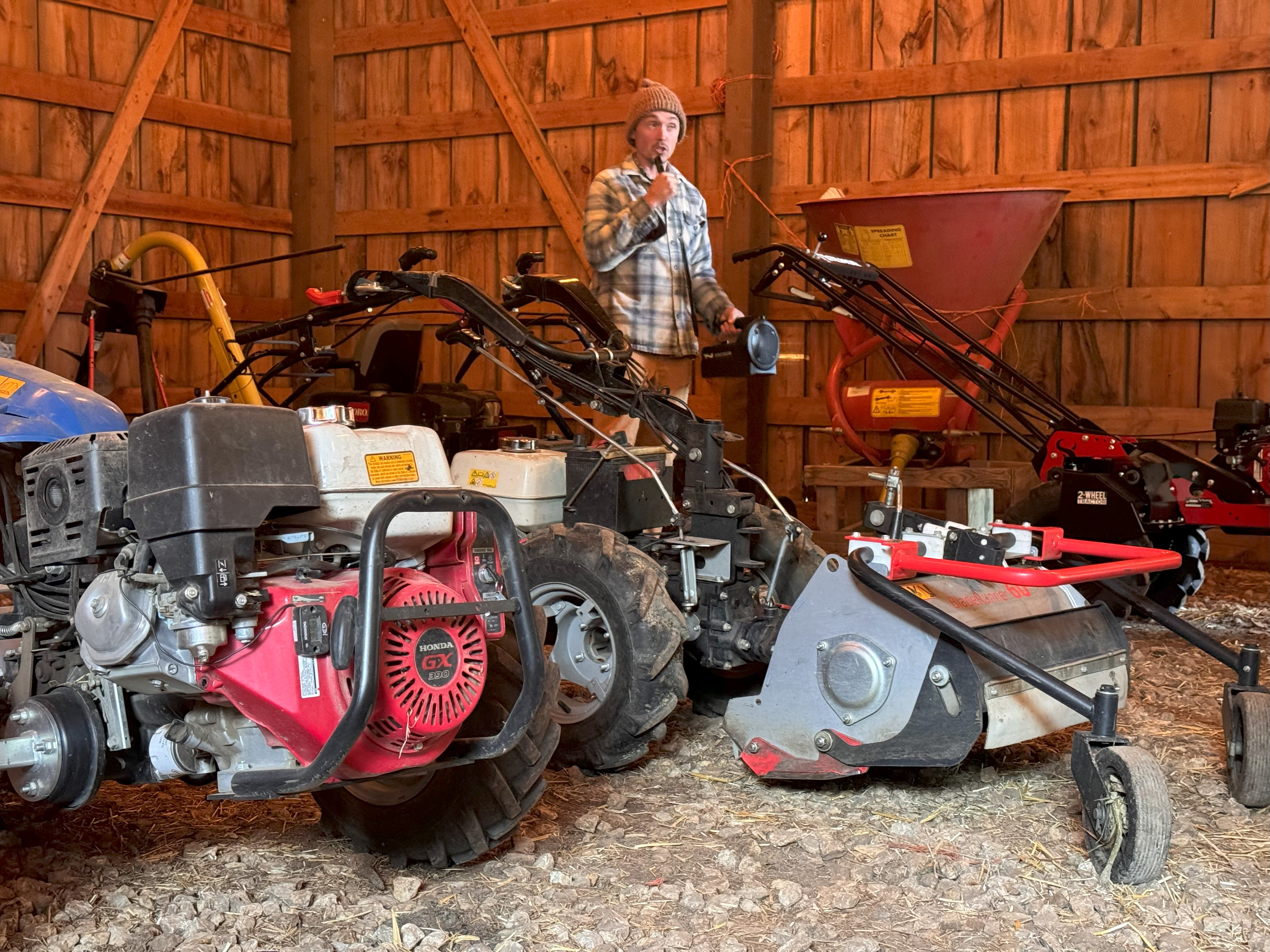
The Burro and Amiga examples point to a pattern. Rather than replacing a whole tractor, these are small carts and robots, with add-ons for jobs such as brush cutting and spot spraying. For many small farms, that is a more realistic entry point than a $100,000 autonomous tractor.
Why the shakeout happened, briefly
The research behind this article cannot fully explain each failure, but the market context is documented. AgFunder reports global agrifoodtech investment fell 49% to $15.6 billion in 2023, then held roughly flat at about $16 billion in 2024 and $16.2 billion in 2025. Deal count fell 12% in 2025. In that climate, companies selling to farmers had to prove a return per acre in a down commodity cycle. USDA's Economic Research Service forecasts 2026 net farm income at $158.4 billion, down 2.6% from 2025.
Monarch's own shift to licensing revenue before it shut down shows how hard the tractor-making side was to sustain.
Other ag robotics firms followed a similar arc. Small Robot Company in the UK was liquidated in 2024. FarmWise wound down in 2025 and was bought by Taylor Farms. Naïo Technologies in France entered receivership in 2025 and was rescued with far fewer staff. Meanwhile, some firms raised money again. The companion article on robotic weeders covers those in detail.
A buyer's checklist for electric or startup equipment
Use this for any machine from a young company, electric or not.
Company and support
- How long has the company sold this model, and how many units are in the field in your region?
- Who services it locally? Get the dealer's name and ask how many units they have serviced.
- What happens to your warranty, parts and software updates if the company is sold or closes? Get the answer in writing.
- Does the dealer carry critical parts, or are they shipped from the maker?
Software and data
- Does the machine run fully without a cloud connection or a paid subscription?
- Can you or an independent mechanic read and clear fault codes?
- Are manuals and diagnostic information available to owners?
Money
- What is the refund policy if promised features, such as autonomy, do not arrive?
- If financing, what do you still owe if the machine becomes unsupported?
- Would a used conventional tractor plus a smaller electric tool cover the same jobs for less risk?
Fit
- List the specific jobs the machine must do each week. Does the vendor show it doing those jobs on a farm like yours?
- Can you visit or call an existing owner who is not paid to promote the product?
A tax advisor or farm financial consultant can help you compare ownership costs. This article is not financial advice.
What to do next
- If you own a Monarch MK-V or Solectrac tractor: save every manual, software version and service record now. Ask your dealer what they can still repair. Check whether any owner groups have formed.
- If you are shopping: start with the jobs, not the power source. Some tasks, such as hauling or row mowing, may suit a smaller electric robot or cart.
- Use the checklist above with every vendor, and compare at least one established brand.
- Watch right-to-repair developments. Access to diagnostic tools matters even more when a manufacturer disappears. See our article on farm right to repair after the Deere settlement.
- Recheck company status before signing anything. This article reflects the situation as of September 2026.
Related reading on this site: our guides to robotic and laser weeders, and to choosing between a two-wheel and compact tractor.
Sources
- Monarch Tractor's collapse ends with an acquisition by Caterpillar — TechCrunch (April 15, 2026)
- Monarch Tractor preps for layoffs and warns employees it may shut down — TechCrunch (November 19, 2025)
- Monarch Tractor shuts down; what went wrong with the $500M electric tractor startup — Farm Progress (April 8, 2026)
- Monarch Tractor bought by Caterpillar — Equipment World (April 16, 2026; updated April 21, 2026)
- Caterpillar Acquires Monarch Tractor — Farm Equipment (April 2026)
- Monarch Tractor's Collapse Exposes Dealer Risks and a Channel in Crisis — Farm Equipment (2026)
- Ideanomics acquires EV tractor manufacturer Solectrac — Electrek (June 14, 2021)
- Ideanomics files for bankruptcy — Truck & Bus Builder (January 10, 2025)
- Ideanomics Liquidating Plan Confirmed — Elevenflo (2026)
- Solectrac domain — solectrac.com (accessed September 17, 2026)
- Bonsai Robotics — Bonsai Robotics (accessed September 17, 2026)
- Burro — Augean Robotics (accessed September 17, 2026)
- Global AgriFoodTech Investment Report 2024 — AgFunder (2024)
- Global AgriFoodTech Investment Report 2026 — AgFunder (March 30, 2026)
- Highlights from the Farm Income Forecast — USDA Economic Research Service (September 3, 2026)
Sources & context
The source links in the draft above are retained as supplied. They are leads for review, not a claim of current verification.
Site publication date: unset. Research and source dates are kept separate. Confirm material use with your certifier and local extension service.
Your follow-up list
Saved in this browser only.